


If you are producing peanut butter, sesame paste, chili sauce, or fruit puree, you’ve likely come across the term colloid grinder. You may wonder, how does a colloid grinder work?– Or want to know:
- Why does it make products into smooth paste?
- Will it prevent oil separation in nut butter?
- Can it achieve the texture my product requires?
This guide explains the working principle in a practical, easy-to-understand way, so you can judge whether a colloid grinder is the right choice for your production.
What Is a Colloid Grinder?
A colloid grinder shears wet or oily materials, like nuts, fruits or vegetables, soaked or cooked beans, into fine and smooth results through high-speed rotor-stator action. It is a kind of wet grinder, which is not suitable for making powder or processing dry and tough materials. It’s widely used for peanut butter, sesame paste (tahini), chili sauce, cocoa paste, fruit puree, soybean milk, and more.
Important: It is not suitable for dry materials or powder production.
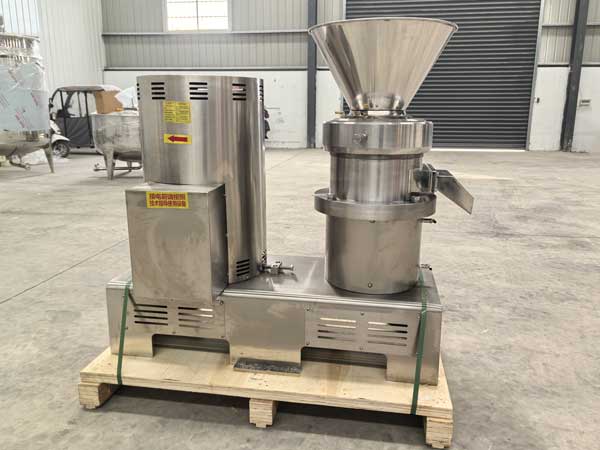
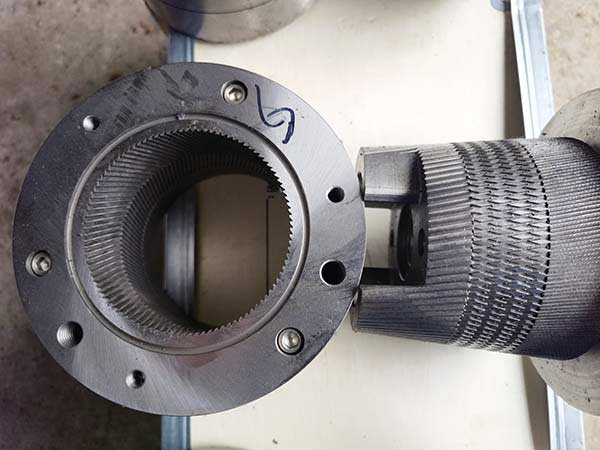
Colloid Grinder Working Principle
1. Core Mechanical Structure
A colloid grinder operates through a rotor–stator system designed for ultra-fine grinding and stable emulsification.
Rotor and stator: The rotor rotates at high speed while the stator remains fixed, forming a narrow working chamber. Fuxun Machinery offers various tooth designs and stator and rotor materials to suit different materials and working conditions.
Adjustable gap: A micrometer-level adjustment mechanism (range: 5-50 μm) allows operators to control the grinding clearance precisely, ensuring consistent smoothness for various sauce textures.
Drive mode: The rotor is powered by a motor, either directly coupled or belt-driven, ensuring stable high-speed operation.
2. Working Mechanism
When the material passes through the small gap between rotor and stator, it experiences a combination of physical forces:
High shear force – breaks down large particles and droplets.
Strong friction and turbulence – create a high-speed vortex that disperses materials uniformly.
Impact and compression – further refine the material in multi-stage grinding zones.
These forces work together to achieve fine dispersion, homogenization, and emulsification within milliseconds.
3. Working Process – Grinding and Emulsifying
When the product enters the working chamber, it passes through three main processing stages:
Step 1 – Shearing: The rotor and stator teeth create a strong cutting force that tears big particles into a coarse slurry.
Step 2 – Fine Grinding: The slurry is squeezed, rubbed, and impacted inside the narrow gap. This reduces particle size down to 1–10 μm — creating a perfectly smooth texture.
Step 3 – Emulsifying: The high-speed motion generates turbulence that blends oil, water, and protein phases evenly. The result is a stable emulsion that won’t separate or release oil over time.

Main Parts of Colloid Grinder
1. Machine Base: Provides a stable foundation for the motor and grinding chamber.
2. Motor and Transmission System: Delivers the high-speed rotation needed for grinding.
3. Rotor & Stator – The Core of the Machine:
- High shear: Breaks and disperses raw materials such as nuts, chili, or sesame.
- Grinding: Compresses, impacts, and rubs particles to micron-level fineness.
- Emulsification: Blends oil, water, and proteins evenly, preventing separation or oil leakage in sauces or creams.
4. Gap Adjustment Mechanism: Precisely adjusts rotor–stator clearance and quickly switches between coarse and fine grinding modes.
5. Feeding System: Ensures smooth, consistent feeding of materials into the grinding zone.
6. Discharge System: Uses centrifugal force to discharge the finished product efficiently.
7. Mechanical Seal System: Prevents product leakage and lubricant contamination.
8. Cooling System: Removes heat generated during grinding to avoid product overheating or color change.
Conclusion
Understanding the working principle is useful — but for most producers, the real question is:
“Will this machine give me the product quality I need?”
From our experience working with hundreds of customers, the answer depends less on theory and more on:
- Your raw material (oil content, moisture)
- Required fineness
- Production capacity
- Whether you need stable emulsification
At Fuxun Machinery, we don’t just supply machines — we help customers match the right configuration to their product. If you’re unsure whether a colloid grinder fits your process or what model you actually need, it’s often faster to discuss your material and target result first — rather than choosing blindly based on specs.